India’s Unemployment Crisis: 7 Stories the Data Forgot
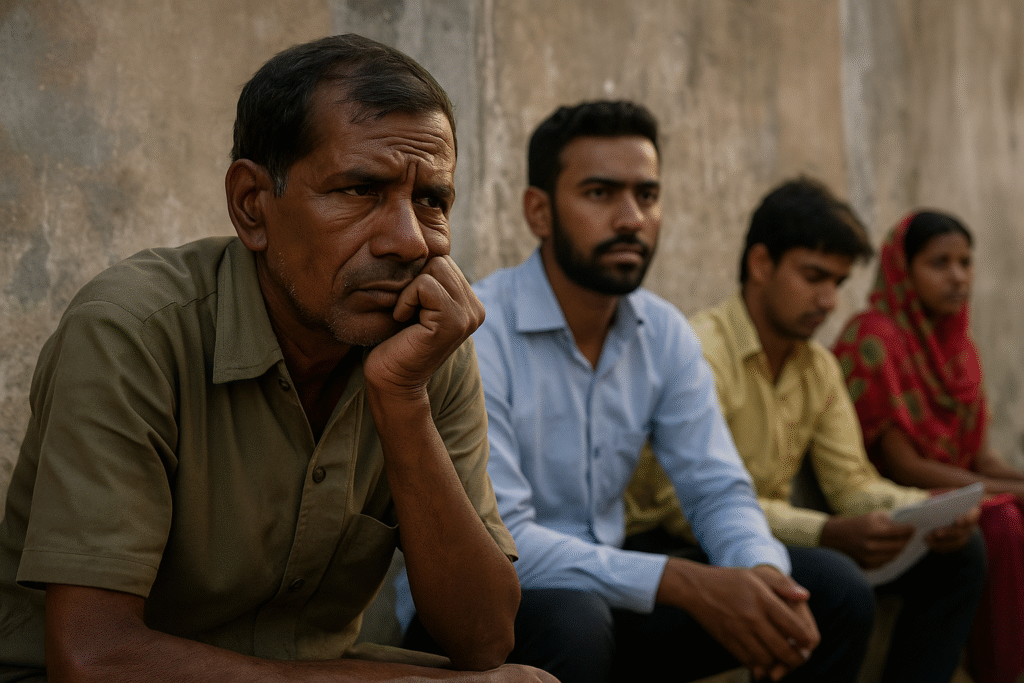
Job seekers sit in uncertainty as India’s unemployment crisis deepens, affecting both skilled and unskilled workers across rural and urban regions.
It is 5:12 a.m. on platform 3 of Patna Junction, and the sleeper coaches are crammed with young men headed for yet another government‐job test in Delhi. Satish Kumar, an engineering graduate from Begusarai, shifts the cloth bundle that serves as his pillow and jokes, “I know the questions by heart now—what I don’t know is whether the train will ever take me to a real job.” His weary smile says more than any spreadsheet about the unemployment crisis in India.
Table of Contents
1. The Exam Nomads
A single vacancy at Indian Railways can attract 1.2 million applicants. For Satish and thousands like him, constant travel has become a way of life, as predictable as the timetable taped beside the ticket window. They are technically “preparing,” but in truth they are trapped in a holding pattern that keeps the unemployment crisis in India swirling like monsoon clouds that refuse to burst.
2. The Overqualified Courier
Nazia Ahmed delivers lunchboxes in Bengaluru’s Indiranagar, weaving between SUVs on a second‑hand scooter she bought with her scholarship refund. She holds a master’s in microbiology. “I memorize routes now, not genomes,” she quips, adjusting the cooler strapped to the pillion seat. Underemployment statistics rarely surface in evening news debates, yet Nazia embodies the most painful contour of the unemployment crisis in India—an education system out of step with the job market it is supposed to serve.
3. The Campus Without Recruiters
St. Anselm’s College in Jabalpur spent ₹2 crore on a new auditorium, assuming recruiters would flock to its doors. This year not a single Fortune 500 company visited. Placement officer Revati Iyer flips through résumés that still smell of fresh ink. “We teach Python and Java, but employers want experience in blockchain deployment,” she sighs. “How do you square that circle?” Her frustration underlines the talent–demand mismatch fueling the unemployment crisis in India.
4. The Vanishing Women
Just after Diwali, garment worker Shalini Devi left her factory job in Tiruppur to care for her ailing mother in Gaya. Six months later she remains at home, stitching blouses for local boutiques at one‑third her old wage. Household expectations, unsafe commutes, and unpaid caregiving push millions of women out of the labor force every year; the unemployment crisis in India is also a gender emergency hiding in plain sight.
5. The Farm That Can’t Feed a Family
Deep in Vidarbha, cotton farmer Ganesh Patil shows me soil that has turned the color of rust. Erratic rain wrecked two harvests; his college‑educated son now minds cattle because there are no factory jobs within a 50‑kilometer radius. Agriculture still employs over 40 percent of Indians, yet contributes barely 15 percent to GDP. Until rural livelihoods diversify, the unemployment crisis in India will keep bleeding families of both money and dreams.
6. The HR Desk That Says “Not Ready”
“All candidates list C++ on their résumé, but few can debug live code,” complains Meena Rao, head of recruitment at a mid‑size fintech in Gurugram. She estimates that just one in ten applicants clears her firm’s basic aptitude test. The National Skill Development Corporation puts employability of fresh graduates at 46 percent; private estimates are lower. Soft‑skill gaps—email etiquette, problem‑solving, teamwork—exacerbate the unemployment crisis in India, turning interviews into exercises in mutual disappointment.
7. The Policy Patchwork
Governments launch schemes—Make in India, Skill India, Startup India—each sincere, none sufficient. Fiscal incentives lure factories, yet land disputes stall them; coding boot camps churn certificates, but internships stay scarce. As a senior bureaucrat confides off the record, “We keep treating symptoms because curing the disease would mean rewriting how schools, cities, and companies function.” Without structural reform, the unemployment crisis in India outpaces every clever acronym thrown at it.
You may also like Cloudburst in Himachal Pradesh: Over 17 Dead in Kullu and Mandi’s Monsoon Nightmare.
A Crisis of Dignity, Not Just Numbers
Official jobless rates—6 percent, 7 percent, pick your source—sound manageable. They miss the hundreds of micro‑stories like Satish’s early‑morning train ride or Shalini’s unpaid caregiving. Each narrative chips away at the social contract that promises education will unlock opportunity. When expectations curdle into resignation, talent migrates—either abroad or into apathy—and the unemployment crisis in India morphs from an economic headache into a threat to social cohesion.
Where Do We Go From Here?
- Revamp curricula with industry input. Universities must collaborate with employers on project‑based learning, so graduates hit the ground running.
- Invest in mid‑sized towns. A single electronics cluster in, say, Raipur could save thousands from moving to megacities already gasping for air.
- Count what matters. Publish underemployment and female labor‐force participation with the same fanfare as GDP growth.
- Make work pay. Extend social security nets—health insurance, pensions—to gig and informal workers, turning jobs into careers.
These steps won’t end the unemployment crisis in India overnight, but they shift the conversation from abstract percentages to lived experience. And that, perhaps, is the first victory: acknowledging that behind every data point lies a person who deserves more than a statistic.
Also read India Out of Work: Unemployed Youth Become ‘Discouraged Workers’.



1 thought on “India’s Unemployment Crisis: 7 Stories the Data Forgot”