7 Powerful Ways AI in Global Healthcare Is Closing the Care Gap
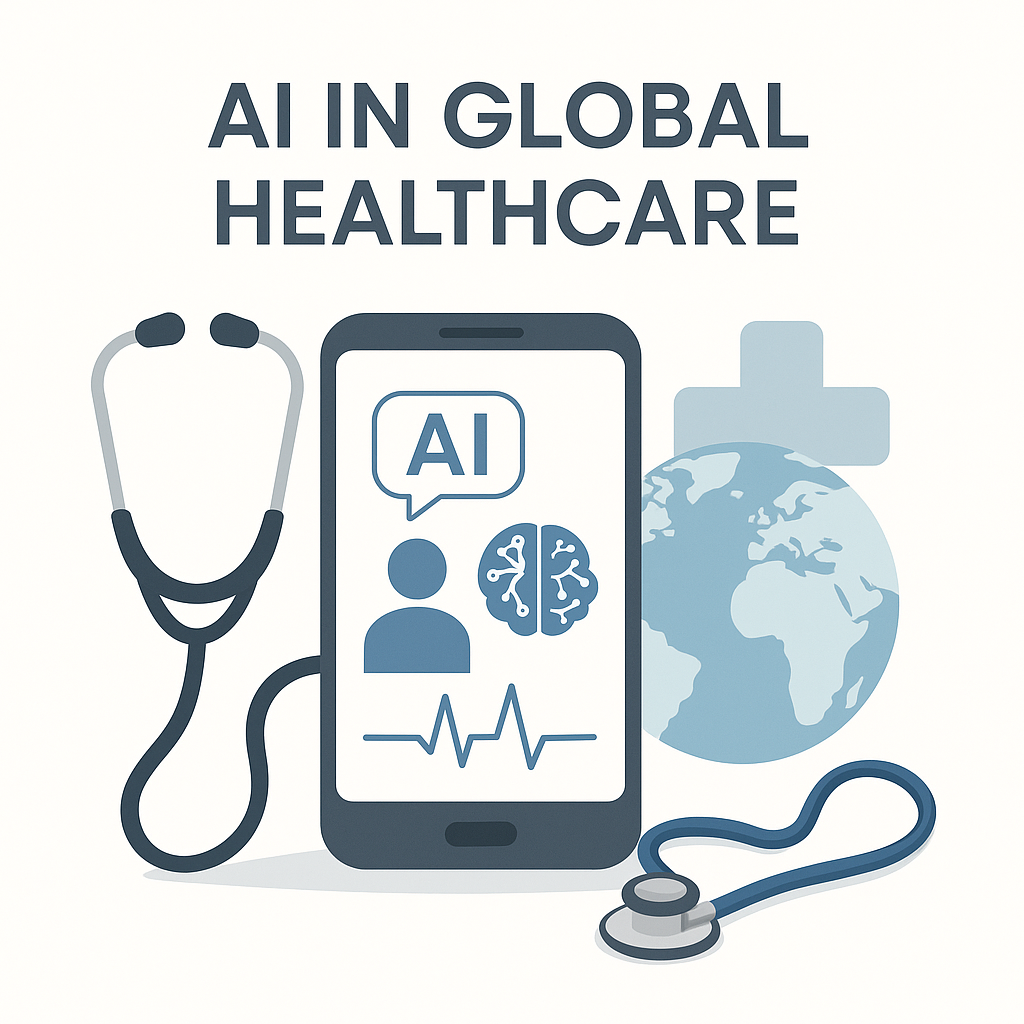
An AI-powered healthcare interface displayed on a smartphone, symbolizing the integration of AI in global healthcare through diagnostics and remote care.
In Sierra Leone, a nurse stares at an X-ray on her smartphone. She’s not a radiologist—there isn’t one within 200 kilometers—but the AI app she’s using has just flagged the image as “highly likely” pneumonia. She doesn’t waste time. The child gets antibiotics. The child lives.
She’s never heard of ChatGPT. But she knows what AI can do.
In high-level conferences and corporate briefings, AI in global healthcare is discussed like it’s a product: scalable, efficient, transformative. In real life, it’s quieter. Messier. A nurse with a shaky internet connection. A health worker squinting at a screen under a flickering light bulb. And yet, it’s working.
Global health has always been unequal. The question now is whether AI will level the field—or just draw new boundaries.
Table of Contents
1. When No Doctors Are Around, AI Fills the Silence
Across much of the world, access to a trained physician is a luxury. In parts of Sub-Saharan Africa, there’s one doctor for every 10,000 people. Clinics in rural India may run for weeks without a doctor showing up. And in refugee camps, even basic triage can fall to volunteers.
This is where AI enters—not with fanfare, but necessity.
Tools like Ada, Qure.ai, and Medtronic’s AI-based platforms are being used to assist health workers in triaging and flagging danger signs. These aren’t perfect systems. They’re not supposed to be. But in places where a wrong decision could cost a life, even a 70% accurate tool is better than a coin toss.
And for many, it’s the only option.
2. The Quiet Power of Language Models No One Talks About
A woman in rural Bangladesh tries to describe abdominal pain—but not in English or even Bengali. It’s a regional dialect. The local health assistant doesn’t speak it. Misunderstandings happen.
Now imagine an AI trained in that dialect, pulling from thousands of speech patterns, suggesting the right translation, and flagging symptoms that might otherwise be dismissed.
This isn’t sci-fi. It’s under quiet development in labs in Nairobi, Dhaka, and Jakarta. While Silicon Valley builds virtual assistants for boardrooms, AI in global healthcare is slowly learning how to listen—to people who’ve never been heard before.
3. Geography Is a Line AI Doesn’t Have to Respect
Distance has always been destiny in healthcare. You’re lucky if you live near a city. If not? Well, you wait. Maybe you survive.
But telemedicine—especially when augmented with AI—changes that. In the Amazon, Brazil’s public health system uses algorithms to flag high-risk pregnancies and notify regional hospitals days in advance. In Australia’s Outback, AI-assisted diagnostic kiosks are being trialed in Aboriginal communities.
Is it smooth? No. Is it revolutionary? Also no. But it’s something—and something matters more than nothing when nothing was all you had.
4. Data Isn’t Just Numbers. It’s Power. And It’s Being Taken.
Here’s the uncomfortable part. AI thrives on data. But in many of the countries where it’s being deployed, data laws are fuzzy at best. Patient images, symptom histories, even audio clips—these are being uploaded, sometimes without consent, sometimes without knowledge.
That data is valuable. And it’s often stored on servers far from the people who generated it.
So who owns it? The local clinic? The health ministry? The tech startup?
No one really knows. And that’s the problem. Unless global safeguards are created, AI in global healthcare risks becoming yet another tool that extracts value from the poor and sells it to the highest bidder.
5. Training Biases Don’t Just Stay on Paper
Let’s say an AI is trained on a million chest X-rays—mostly from patients in California and London. It performs brilliantly there. But what happens when it’s shown an image from a malnourished child in rural Sudan?
It guesses. Sometimes wrong. Sometimes very wrong.
Medical AI, like any model, reflects the data it’s trained on. When datasets aren’t diverse, the models don’t perform equitably. And when they fail quietly, people get hurt.
That’s not an argument against AI. It’s an argument for better, more inclusive AI. Because AI in global healthcare can’t serve the world if it doesn’t understand the world.
You must read Mental Health Issues Among Indian Teenagers Post-COVID: A Crisis India Can’t Ignore.
6. AI Can’t Run on Empty
Everyone loves a sleek health app—until the clinic loses power. Or the tablet battery dies. Or the cellular tower goes offline.
In many parts of the world, tech infrastructure is fragile. AI can’t fix that. It depends on it. That’s why deploying AI without investing in basics—electricity, internet, equipment—is not just shortsighted. It’s cruel.
It gives the illusion of care without the support to make it real.
So, before installing algorithms, maybe install solar panels.
7. No, AI Won’t Replace Doctors. But It Might Replace Silence.
There’s this fear in high-income countries that AI will make doctors obsolete. That’s not the fear elsewhere. The fear in rural Kenya or central Myanmar is that the doctor will never come at all.
In that context, AI isn’t a threat—it’s a stand-in. A stopgap. A lifeline.
Whether it’s helping a nurse interpret a scan, alerting a pharmacist to a drug interaction, or sending a reminder to a diabetic patient’s basic feature phone, AI in global healthcare isn’t erasing humans. It’s making sure someone shows up—even if digitally.
Final Thought: It’s Not About the Tech. It’s About the Choice.
Technology rarely changes the world on its own. What changes the world is how we choose to use it—and who we choose to include.
AI won’t end inequality. But it could reduce it. If we fund the right projects. If we insist on ethical data use. If we train models on all skin colors, all voices, all lives—not just the profitable ones.
AI in global healthcare is just a tool. But sometimes, a tool in the right hands is all it takes to build something better.
Also go through AI Is Quietly Reinventing Healthcare–And Real Deployments Are Now Underway.